Release 4.1
 Contents |
 Index |
| Discoverer 4i Plus Online Help Release 4.1 |
|
When you use Analytic Functions in Conditions, the way that you combine them with non-Analytic Functions affects the Discoverer data returned by the query. The following sequencing rules apply:
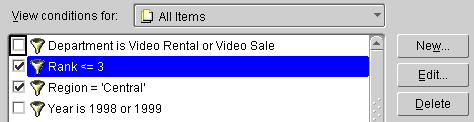 Where Conditions contain only non-Analytic functions, these are applied before Conditions that contain Analytic functions.
In the example right, the `Region = `Central' condition is applied first, then the Rank is computed, then the `Rank <= 3' condition is applied, (which contains an Analytic function).
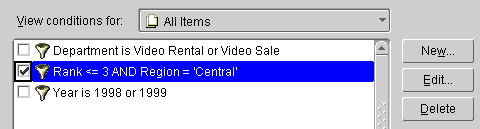 Where Conditions contain a combination of non-Analytic functions and Analytic functions, the Analytic functions are applied before the non-Analytic functions.
In the example right, the Rank is evaluated, then the `Rank <= 3' condition is applied, then the `Region = `Central' condition is applied.
To illustrate how sequencing affects the Discoverer data returned by a query, consider the following two scenarios.
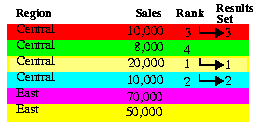 In the first scenario, we apply two simple Conditions: Region = `Central', and Rank <= 3 (where Rank is an Analytic Function).
The Region = `Central' condition is applied first, then Rank <= 3.
Therefore, only Sales figures for the Central Region that have a ranking of three or less are included in the Results Set.
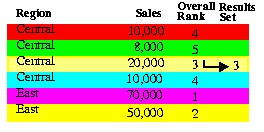 In the second scenario, we apply a single advanced Condition: Region = `Central' AND Rank <= 3, (where Rank is an Analytic Function).
The Rank <= 3 condition is applied first, then the Region = `Central' condition.
Therefore, only figures in the Central Region that have an overall ranking of three or less are included in the Results Set.
|
|
 Copyright © 2000 Oracle Corporation. All Rights Reserved. |
|